The #1 Reason Patients Call Isn't Illness — It's Scheduling
Contents
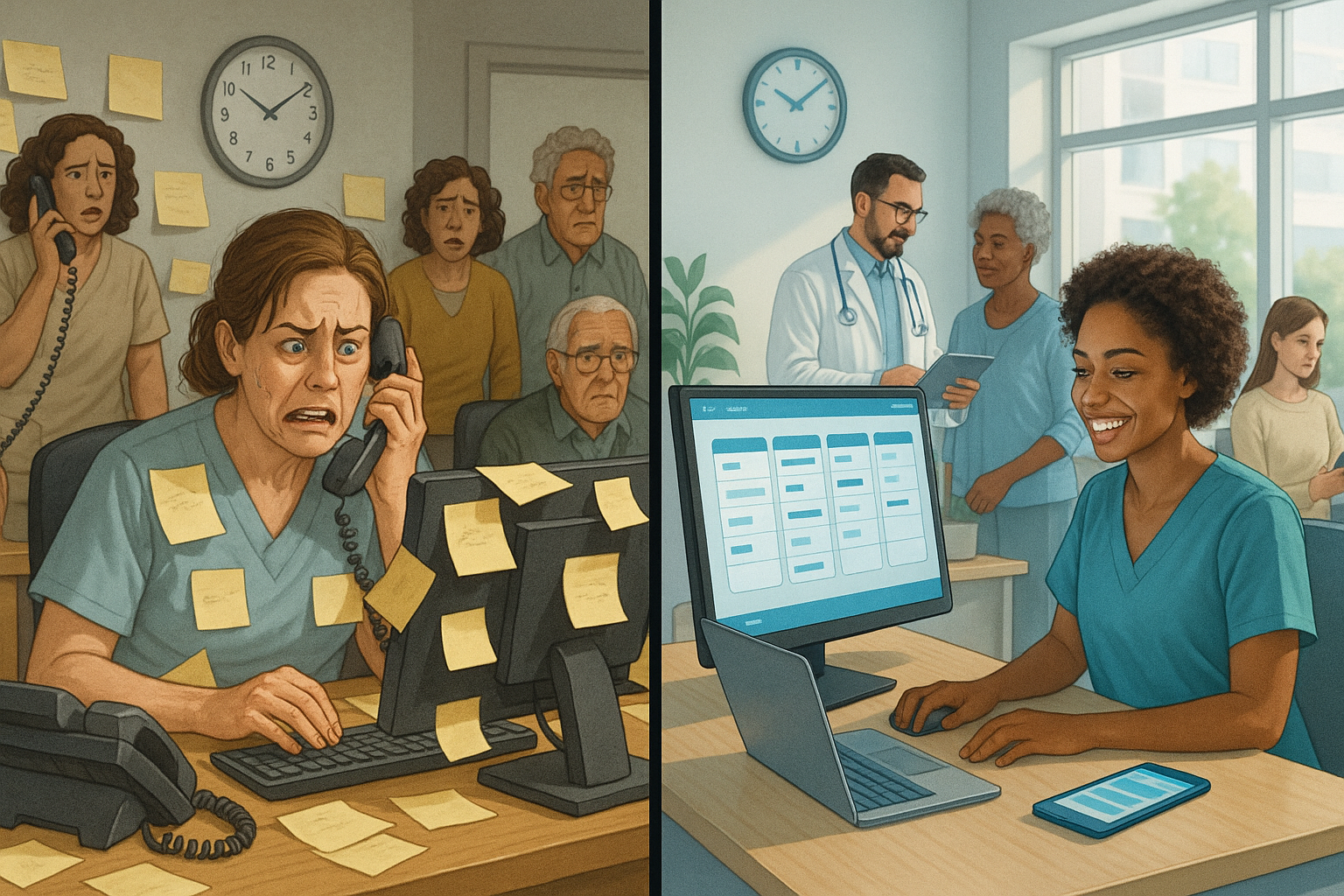
Quick Answer: Across 494,097 classified patient calls, appointment scheduling was the single most common reason patients picked up the phone — 25.7% of all calls, more than prescription refills, billing, and test results combined. Yet only 6.6% of those scheduling calls were resolved on the first call; 48.9% ended in a callback. Scheduling is the largest, most routine, and most automatable category of patient calls — yet routing every one through a live receptionist is what turns a fifteen-second task into phone tag.
When most people picture a busy medical practice's phone lines, they imagine sick patients describing symptoms, worried parents, urgent refill requests. That picture is wrong — or at least, it's a small slice of reality.
We classified 494,097 patient phone calls drawn from the more than 29 million call sessions CallMyDoc has handled for ambulatory practices across 44 states plus DC and the US Virgin Islands. We tagged each call by why the patient called, who was calling, whether the request was routine or urgent, and how it was resolved. One category dwarfed every other — and it wasn't anything clinical.
The #1 reason patients call isn't illness — it's scheduling
Appointment-related calls accounted for 25.7% of all patient calls (127,120 of 494,097). That is more than one in every four calls a practice fields. For comparison, the next-largest reasons trail far behind:
- Appointments — 25.7%
- Callbacks/returned calls — 13.0%
- Prescription refills — 8.3%
- Prescription issues — 8.1%
- Messages for a provider — 7.9%
- Billing & insurance — 4.9%
- Test results — 3.4%
Put another way: appointment scheduling generates more call volume than refills, billing, and test results combined (which together make up 16.6%). The thing your front desk spends the most time on isn't medicine. It's logistics.
This matters because logistics is precisely the kind of work that does not require a clinically trained human on the other end of a phone line. Yet in most practices, it consumes the same staff, the same phone queue, and the same hold music as everything else.
The surprise: most scheduling calls aren't about booking a new appointment
Here is where the data gets genuinely counterintuitive. When practices think about self-scheduling, they usually picture a new patient booking a first visit. But that's the minority of the work.
Of the 127,120 appointment calls, the breakdown was:
- Schedule a new appointment — 44.7%
- Reschedule an existing appointment — 29.1%
- Confirm an appointment — 17.0%
- Cancel an appointment — 9.1%
Add up the last three and you find that 55.3% of all appointment calls are not new bookings at all — they're patients managing an appointment they already have. Rescheduling, confirming, canceling. That's 14.2% of a practice's entire call volume spent on appointment churn alone.
This is the hidden workload nobody budgets for. A practice can have a perfectly efficient new-patient intake process and still drown, because more than half of its scheduling calls are about appointments that already exist in the calendar. Every "I need to move my Thursday visit to next week" is a phone call, a hold, a lookup, and often a callback — for a task the patient could complete in fifteen seconds if the system let them.
The bottleneck isn't the phone — it's the person in the middle of every call
If scheduling were getting handled efficiently, the volume alone wouldn't be alarming. But it isn't. Look at how appointment calls actually resolved:
- Resolved on the first call — 6.6%
- Ended in a callback — 48.9%
- Left unresolved — 35.4%
Read that first number again. Roughly one in fifteen scheduling calls actually got the patient's task done on the first try. Nearly half ended with someone promising to call back — which means a second call, a second hold, a second chance to miss each other. This is phone tag, at scale, for tasks that are fundamentally simple.
It's tempting to blame the phone — but the phone isn't the problem. Patients overwhelmingly prefer it: more than 80% of all patient–practice communication still happens by phone, and that isn't changing. The problem is what sits behind the phone — a live person who has to be available at the very same moment as the patient. Scheduling is an asynchronous task (find a time that works for both sides); it only becomes a synchronous ordeal because a human is doing the matching in real time. That mismatch is what produces the callbacks and voicemails. And it's structural, not scheduling-specific: across all 494,097 calls, just 3.7% resolved on first contact. The failure follows the human handler, not the handset.
For a patient, the experience is maddening: you call to move an appointment, wait on hold, and are told someone will call you back. For a practice, every one of those callbacks is staff time spent not on care, but on chasing a calendar change.
So what — and the fix, in one line. The takeaway isn't "answer the phone faster," and it isn't "push patients to a portal" — it's "take the receptionist out of routine scheduling, on the channel patients already use." CallMyDoc's ScheduleMyPatient lets patients book, reschedule, confirm, or cancel themselves over the phone — in seconds, with just their date of birth and name, no login and no hold — and writes the change straight back into athenahealth. The one-in-four calls that are scheduling stop becoming phone tag, and your team's line stays clear for the patients who genuinely need a person.
The research agrees — and it points at the portal, not the phone
Our call data isn't an outlier; it lines up with the peer-reviewed literature on patient self-scheduling. In a study of more than 13,000 well-child appointment actions at Mayo Clinic, published in JMIR Medical Informatics, staff-scheduled appointments required more than one step — a schedule, cancel, or reschedule cycle — 28% of the time, while patient self-scheduled appointments were completed in a single step 93% of the time (North et al., 2021). Nearly 30% of self-scheduling happened outside regular business hours, and no-show rates were no worse than staff-booked visits.
But there's a catch that explains why scheduling stays stuck on the phone: only about 5% of scheduling actions actually went through the self-scheduler — because it lived in a patient portal, behind a login. That is the login-friction problem in miniature. The capability works beautifully; patients just won't dig out a username and password to use it.
Put the two findings together and the path is obvious. Self-scheduling collapses a multi-step, phone-tag-prone task into a single step — exactly the failure our 494,097 calls expose from the other end of the line. The only thing standing in the way is asking patients to leave the channel they already use. Keep it on the phone and drop the login, and the adoption problem goes with it.
Why scheduling is the textbook case for self-service
Three more findings from the data explain why this enormous, failure-prone category is also the easiest to fix.
It's overwhelmingly routine. 88.5% of appointment calls were classified as routine, with only 11.4% urgent and a fraction of a percent emergent. Scheduling is not where clinical risk lives. Deflecting it to self-service doesn't mean missing something dangerous — it means freeing your team to catch the calls that are dangerous.
It's highly automatable. 91.9% of appointment calls were classified as fully or partially automatable — the highest of any major category. These are structured tasks with clear inputs: a patient, a provider, a date, a reason. They map cleanly onto software.
It reaches the right person. 85.5% of appointment calls came from the patient themselves, not a family member or outside office. That means a self-scheduling tool reaches the actual decision-maker — the person who knows their own availability — rather than a proxy who has to relay and call back.
Even under the strictest possible definition — calls our classifier flagged as unambiguously self-schedulable, with no judgment call required — 10.7% of every patient call qualified. That's the conservative floor. The realistic opportunity, given how routine and automatable the broader appointment category is, is considerably larger.
What this means for practices
The instinct, when phone volume climbs, is to add staff or extend hours. The data suggests a different first move: stop putting a person in the middle of your single largest, most routine call category.
The usual answer to that is "push patients to the portal." But that's exactly why scheduling stays stuck on the phone — portals ask patients to remember a website, a username, and a password, and most simply won't. The research bears this out, and so does our experience: adoption stays low, and the calls keep coming. The lesson from the data is the opposite of "replace the phone" — don't fight the channel patients prefer; automate the work on it.
That's what CallMyDoc's ScheduleMyPatient does. A patient calls a dedicated number and books, reschedules, confirms, or cancels in seconds — identifying themselves with just a date of birth and name, no login, no hold, no receptionist — and the change writes straight back into the EHR. (A mini-website is there for patients who prefer to tap rather than talk.) The four tasks a patient can self-serve are the exact four that make up 100% of appointment calls, and the 55% that are pure churn stop generating phone tag. On athenahealth today it slots into the practice's existing self-scheduling setup, while urgent and complex calls still route to your staff — any patient who needs a person still reaches one, every time.
This is what we mean when we describe CallMyDoc as clinical communication infrastructure rather than a receptionist: not a friendlier voice on the same phone-tag loop, but the routine, structured work taken off your team's plate so their time goes to the conversations that actually require human judgment. For a fuller picture of how patient call patterns break down — and which calls still genuinely need a human — see our analysis of what patient phone calls reveal about a practice's day.
Frequently asked questions
What percentage of patient phone calls are about scheduling?
In an analysis of 494,097 classified patient calls, 25.7% were appointment-related — the single most common reason patients called, exceeding prescription refills, billing, and test results combined.
Are most scheduling calls for booking new appointments?
No. Only 44.7% of appointment calls were to book a new appointment. The majority — 55.3% — were to reschedule (29.1%), confirm (17.0%), or cancel (9.1%) an existing appointment.
Why is phone scheduling so inefficient?
Only 6.6% of appointment calls were resolved on the first call, and 48.9% ended in a callback. The inefficiency isn't the phone itself — patients prefer calling — it's that a live person has to be available at the same moment as the patient to match a time. Automating the call so patients can self-schedule over the phone removes that bottleneck, completing the task on first contact instead of creating phone tag.
Is appointment scheduling safe to automate?
Scheduling is the lowest-risk, most structured category of patient call: 88.5% of appointment calls were routine, and 91.9% were fully or partially automatable. Self-scheduling handles these routine tasks while any urgent or complex call still reaches a member of staff — patients are never prevented from reaching a person.
Does CallMyDoc offer self-scheduling?
Yes. CallMyDoc's ScheduleMyPatient lets patients book, reschedule, confirm, and cancel appointments directly, writing changes back into the EHR. Self-scheduling is available for practices on athenahealth today.
Related reading: What 494,000 patient phone calls reveal about why patients call — the full overview behind this analysis.
Scheduling is the #1 reason patients call. See how CallMyDoc handles it.
Patient self-scheduling on athenahealth today, with every scheduling call answered and documented on Veradigm and Altera TouchWorks.
Book a demo →