Automated Prescription Refill System for Practices
Contents
Quick Answer: An automated prescription refill system lets patients request refills by phone — any time, day or night — without waiting on hold or leaving a voicemail. The patient identifies themselves by date of birth, states the medication and pharmacy, and the request is captured and routed straight to the provider, who fills out the refill in the CallMyDoc app — which then sends it to the pharmacy, updates the chart, and calls the patient to tell them where to pick it up. The system never decides whether a refill is appropriate; it removes the phone tag and the busywork so the clinical decision stays with the provider.
Prescription refill requests are one of the highest-volume, most repetitive calls a medical practice handles — and one of the most disruptive. They pull front-desk staff off other work, generate voicemail backlogs, and interrupt providers mid-visit for what is often a one-tap approval. In family medicine, refill requests make up roughly 19% of all patient calls; in OB/GYN, about 11%. That's a steady, predictable stream of calls that rarely needs a live conversation at all.
This guide explains how an automated prescription refill system works, what it replaces, and where the human stays firmly in the loop — drawn from how CallMyDoc handles refill calls across its practices.
Why refill calls clog the front desk
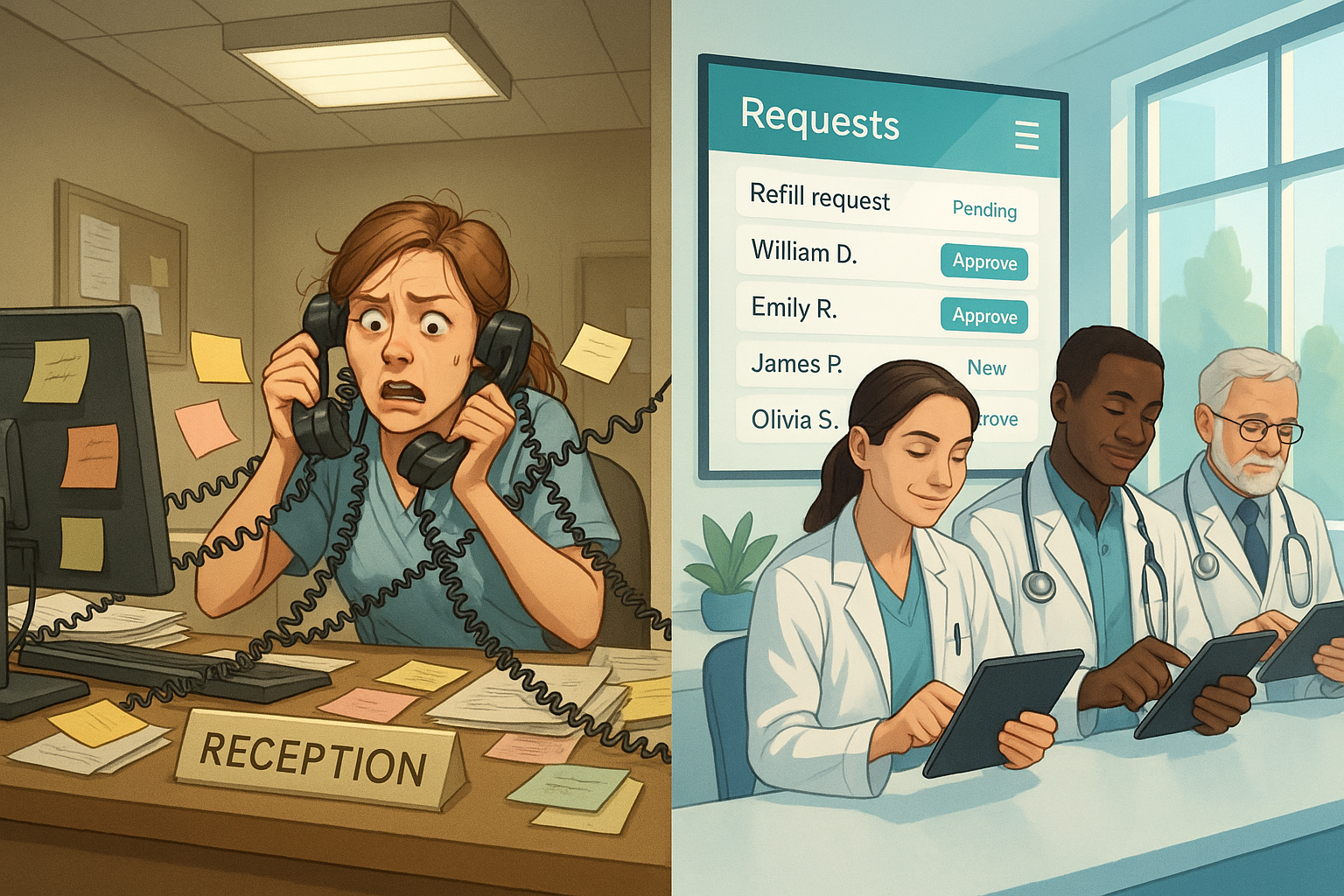
The traditional refill workflow is built for delay. A patient calls, waits on hold, and often lands in voicemail. A staff member listens to the message, transcribes the medication and pharmacy (a transposition error waiting to happen), and routes it to the provider. The provider gets interrupted, or the request sits until end of day. Meanwhile the patient has no confirmation their refill was even received.
The result is familiar to every practice: missed refills, phone tag, and constant provider interruptions for a task that is mostly administrative. Multiply that by dozens of refill calls a day and it becomes a meaningful drain on both staff time and patient trust.
The failure modes are specific to refills. A transposed digit in a drug name, a misheard dose, or the wrong pharmacy on file means the patient arrives at the counter to find nothing waiting — then calls back, restarting the whole cycle. Controlled-substance refills add documentation requirements that a hurried voicemail-to-sticky-note workflow handles poorly. None of this is the provider's clinical judgment failing; it's the intake process around the decision that breaks down.
The real cost of a missed refill
A refill request isn't just an administrative task — it's a point in a patient's care where therapy can quietly break down. When a request falls into a voicemail backlog or gets lost in phone tag, the patient may go days without medication. For chronic conditions like hypertension, diabetes, or depression, those gaps matter. Medication non-adherence has been documented for decades — the World Health Organization has long estimated that roughly half of patients with chronic illness don't take their medications as prescribed, and access friction is one well-known contributor.
Seen that way, every refill call a practice fails to capture cleanly is a small continuity-of-care risk, not just a missed task. An automated system that reliably captures and routes every request — including the after-hours ones — turns refill handling from a leaky manual process into a closed loop. That protects continuity of care as much as it protects staff time.
How automated prescription refill capture works
An automated refill system replaces the hold queue and voicemail with structured, instant capture. With CallMyDoc, the flow is:
- The patient is identified automatically. They call a dedicated number, and the system matches them to their chart by date of birth — no portal login, no app.
- The refill request is captured cleanly. The patient states the medication and their pharmacy. The request is transcribed and structured — no staff member retyping a voicemail, no transposed drug names or wrong pharmacies.
- It routes straight to the right person. The structured request lands as a task for the provider or designated staff, with the patient's chart context attached — not a sticky note or a voicemail to chase down.
- The provider fills out the refill in the app. From the CallMyDoc mobile app, the provider reviews the request with chart context and completes the refill. The clinical decision stays entirely with the provider.
- The app closes the loop automatically. Once the refill is completed, the app sends it to the patient's pharmacy, updates the patient's chart, and calls the patient to tell them their prescription is ready and where to pick it up — with no staff member touching any of it.
This is the critical distinction: the system captures and routes the request — it does not decide whether a refill is clinically appropriate. There is no AI judging medications, doses, or whether a prescription should be renewed. That judgment belongs to the provider, every time. What automation removes is the phone tag, the transcription errors, and the interruptions — not the clinical oversight.
After-hours and weekend refill requests
Refill requests don't keep business hours. A patient who realizes at 9 PM that they're out of medication shouldn't have to wait until the office reopens — and your staff shouldn't return to a Monday voicemail backlog. Because the system runs 24/7, after-hours refill requests are captured the moment the patient calls and queued as structured tasks for the provider to action. Nothing is lost, and nothing requires a staff member to be awake.
For practices, this closes one of the most common after-hours gaps: the patient who calls about medication and, under a traditional answering service, either gets a delayed callback or no documentation at all. With automated capture, every request is timestamped and recorded.
What it replaces — and what changes
Automating refill calls is part of a broader pattern. Across more than 29 million patient calls handled in 44 states plus DC and the US Virgin Islands, CallMyDoc fully automates roughly 47% of inbound call volume — and refills are one of the most automatable categories, because they follow a clear, repeatable structure. When refill requests become structured EMR tasks instead of phone calls, practices see:
- Fewer provider interruptions — refills arrive as a reviewable queue, handled when convenient, not as mid-visit phone calls.
- No transcription errors — the medication and pharmacy are captured directly from the patient, not relayed through a message-taker.
- No missed refills — every request is captured and tracked, with a timestamped record.
- Freed front-desk time — staff stop fielding the same routine refill call dozens of times a day.
It all runs through the same AI-powered patient call platform that handles scheduling, after-hours coverage, and messaging — so refills, appointments, and clinical questions share one system and one record. (For a broader view of which calls automate cleanly and which still need a human, see which patient calls can be automated.)
Which practices carry the heaviest refill load
Refill burden tracks with chronic-disease management. Practices that manage long-term medications — family medicine, internal medicine, endocrinology, cardiology, and nephrology among them — field the highest refill volumes, often dozens of maintenance-prescription requests a day. In family medicine, refills alone account for roughly 19% of all patient calls; in OB/GYN, about 11%. For these practices, automating refill capture isn't a marginal convenience — it removes one of the single largest, most repetitive sources of inbound call volume, without touching the clinical decision that follows.
High-volume, chronic-care practices also benefit most from the documentation side. When every refill request is timestamped and written back to the chart, the practice gains a complete, auditable record of what was requested and when it was actioned — useful for continuity, for covering providers, and for compliance.
Works across your EHR
CallMyDoc's call automation — including refill capture and routing — works with athenahealth, Veradigm, and Altera TouchWorks. Captured requests are documented back to the patient record, so the refill, its timestamp, and the provider's action live in the chart rather than on a message pad.
What to look for in an automated refill system
If you're evaluating options, the details that separate a real solution from a glorified voicemail box are refill-specific:
- Accurate patient identification — the system should match the caller to the chart automatically (by date of birth), so the request is tied to the right record before anything else happens.
- Structured capture, not transcription — medication and pharmacy should be captured as clean, structured data, not a recorded message someone has to listen to and retype.
- Provider completes the refill in-app, with chart context — the provider should be able to review and complete the refill from a mobile device, with the patient's context attached.
- Closed loop to pharmacy, chart, and patient — once the provider completes the refill, the system should transmit it to the pharmacy, write the outcome back to the chart automatically (timestamped), and call the patient with pickup details — not leave those steps to staff.
- 24/7 capture — after-hours requests should be caught and queued, never dropped to a backlog.
- A clear human-in-the-loop boundary — the system should capture and route, never auto-approve. Be wary of any tool that claims to "decide" refills.
The human stays in the loop — by design
It's worth restating, because it's the part that matters most to clinicians: an automated refill system is not an automated prescriber. CallMyDoc never approves, denies, or evaluates a refill on its own. It handles the administrative load — identifying the patient, capturing the request accurately, routing it with chart context, and then, once the provider completes the refill, sending it to the pharmacy, updating the chart, and calling the patient with pickup details — so the provider's clinical decision is faster and better-informed, not removed. Automation absorbs the busywork; the provider keeps the judgment.
See it on your practice
The fastest way to evaluate fit is to see refill capture working end to end — from the patient's call to the provider's one-tap approval. Book a demo → and we'll walk through how automated prescription refill handling would work for your practice and your EHR.