Three Eras of Medical Phone Coverage — and What Each One Lost
Contents
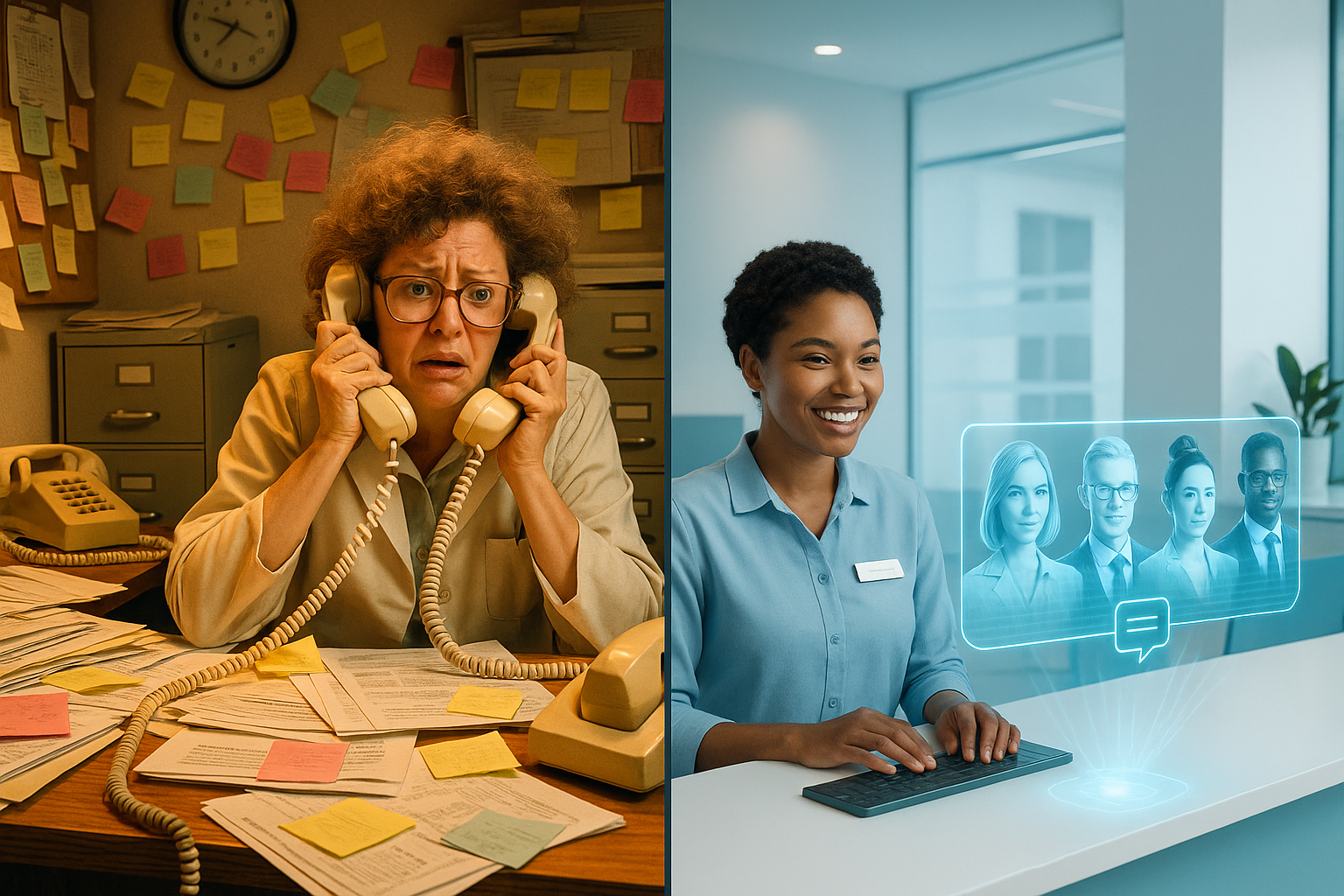
Quick Answer: Medical practices have tried to scale phone coverage three times in the last forty years. Each wave — in-house receptionists, outsourced call centers, and now fully autonomous AI — gained capacity but gave up something the previous wave had: proximity, context, or human presence. The hybrid model (AI for routine volume, humans for the calls that need a person, full context preserved across the handoff) is the first attempt where scale doesn't cost the patient relationship. Owners and MSOs evaluating phone-coverage architecture should think in eras, not features.
The phone-coverage problem isn't new
Every medical practice owner who has ever stared at a missed-call report is wrestling with the same problem the industry has been trying to solve since the 1980s: how do we answer every patient call without burning out the people answering them?
The answer has been re-invented three times. Each version scaled what the previous one couldn't. Each version also lost something the previous one had. Understanding that pattern is the most useful thing an owner or operator can do before evaluating any AI phone vendor — because the right question isn't "should we use AI?" It's "which tradeoff are we making this time, and is the patient relationship one of them?"
Era 1: The receptionist era (1980s–2000s)
For most of modern medical practice, the front desk was the patient communication strategy. A single in-house receptionist (or a small team) answered the phone, knew the regulars, and knew when something was off. That proximity wasn't a feature anyone designed. It was a side effect of being small.
Sachin Jain, president and CEO of Scan Health Plan, described what that proximity actually does in a May 2025 KFF Health News piece: a receptionist at a small practice may know the patients well enough "to pick up on subtle cues and communicate to the doctor that a particular caller is somebody that you should see, talk to, that day, that minute, or that week." That subtle-cue detection — reading tone, history, and context to triage urgency in the moment — was the implicit value of the era.
What scaled: proximity, context, judgment.
What didn't scale: capacity. One receptionist can't answer fifty simultaneous calls. After-hours coverage required a second team or an answering service. Burnout was endemic. The Medical Group Management Association has reported for years that front-desk turnover is the highest of any role in ambulatory medicine. Practices outgrew the model long before they wanted to.
Era 2: The call center era (2000s–2020s)
The next layer was outsourcing. Practices — first hospitals and large groups, eventually mid-sized clinics — routed inbound calls to centralized contact centers, often offshore. The economics were obvious: 24/7 coverage, no payroll for in-house staff, capacity that flexed with call volume. By the end of 2024, the medically-focused call-center workforce in the Philippines alone was around 200,000 workers, per industry trade group figures cited by KFF.
What got built was a layer that could scale almost infinitely. What got lost was harder to put on a P&L. Ruth Elio, an occupational nurse who supervised call-center workers handling calls for Americans with diabetes and neurological conditions, told KFF that the human relationship is exactly what the model can't replicate: "The rapport, or the trust that we give, or the emotions that we have as humans cannot be replaced." A Kaiser Permanente call-center nurse described the operational reality from inside: a "very micromanaging environment" where "from the beginning of the shift to your end, you're expected to take call after call after call from an open queue." That is not a context in which subtle-cue triage is possible.
The call center era also introduced a structural gap that didn't exist in the receptionist era: the person answering the phone usually wasn't the person who knew the patient. Context lived in the chart, but rarely got read in the seven seconds an agent had before saying hello. The Sachin Jain "somebody you should see today" instinct doesn't survive a queue.
What scaled: capacity, after-hours coverage, cost predictability.
What didn't scale: context, proximity, judgment. The patient relationship was the price of capacity.
Era 3: The AI-only era (2023–now)
The third layer is the one being marketed right now. Fully autonomous AI voice agents promise to do everything call centers do, faster and cheaper, and without the staffing volatility. The economics, again, are obvious. The pitch, again, hides what gets traded away.
The failure modes are already public. The Telegraph reported in April 2026 on AI receptionists deployed at UK GP clinics generating lengthy phone calls, hanging up on patients, and failing to understand regional accents — operational problems that quickly became reputational ones. KFF's own piece flagged the structural skepticism inside the industry: a study in Nature Medicine found that while some AI models can diagnose conditions when fed a clean clinical anecdote, they "struggle to elicit information from simulated patients." The skill of conducting a conversation that surfaces what the patient hasn't said yet — the actual job of triage — is still unreliably automated.
Research on AI in clinical contexts has been warning about this for years. Foundational trust-in-AI research argues that healthcare adoption depends not on raw capability but on whether the system supports clinicians in the moments that matter — not by replacing the relationship, but by reinforcing it. Systems that bypass the relationship erode the trust they need to function.
What scales: volume, after-hours coverage, near-zero marginal cost per call.
What doesn't scale: judgment, accent and language coverage, recovery from edge cases, the willingness of a frustrated patient to keep using your practice instead of switching to one where they can talk to someone.
The pattern: every wave scales by losing something
Three eras. Three different tradeoffs. The same underlying pattern.
| Era | What it scaled | What it lost |
|---|---|---|
| Receptionist | Context, proximity, judgment | Capacity, after-hours, cost |
| Call center | Capacity, after-hours, cost | Context, proximity |
| AI-only | Volume, marginal cost | Human presence, recovery, judgment |
| Hybrid AI + human | All of the above | Requires deliberate routing design |
The interesting row is the last one. The hybrid model is the first phone-coverage architecture in forty years that doesn't ask owners to trade one column for the other. It uses AI for the call volume that doesn't need a human, and humans for the call volume that does — with the context layer wired between them so the patient never has to start over.
How the hybrid model actually keeps what each era lost
The reason hybrid doesn't repeat the pattern is that it doesn't try to replace the prior layers. It composes them.
- The receptionist's context survives because the AI front layer carries the patient's chart, history, and call transcript into every interaction. When a call routes to a human, the human picks up with the full record visible — the equivalent of a small-practice receptionist's institutional memory, applied at scale.
- The call center's capacity survives because AI handles the high-volume, low-judgment tier: reminders, refills, simple daytime scheduling, FAQs, after-hours information. The economics resemble (and improve on) a call center for those workflows.
- The human presence survives because the architecture is built around the assumption that some percentage of every day's calls will require it. The default failure mode of a well-designed hybrid system isn't "loop." It's "human." Uncertainty triggers escalation, not retry.
The operational design that makes this work has a few specific properties. Calls are routed by the urgency the patient selects and their stated intent on arrival, not by deflection target. Urgent keywords (chest pain, post-op symptoms, severe pain, bleeding) route immediately to a live human — clinical staff during business hours, on-call providers after hours. When AI hands off, it passes the call transcript and the patient's EHR record to the human before they pick up, so the caller doesn't repeat themselves. Every call — AI-handled or human-handled — is logged into the EHR with timestamp, the urgency the patient selected, and outcome, which gives the practice the documentation a call center never produced and the audit trail a fully-autonomous AI deployment rarely preserves.
What this looks like in CallMyDoc's numbers
We've operated this hybrid model across 27+ million patient calls for ambulatory practices in 44 states plus DC and the US Virgin Islands. The shape of the workload is consistent across specialties:
- About 47% of calls are resolved entirely by AI — the reminder/refill/simple-scheduling tier that maps directly to the call-center era's strengths.
- The other 53% route to human staff with full transcript and chart context preserved across the handoff — the receptionist-era value, applied at scale.
- After-hours callbacks through the CallMyDoc app: 4.7-minute median. Measured from the end of the patient's call when the patient selects the urgent option and the on-call provider calls back in the app (17,504 calls, 141 practices, Dec 2025 to Sep 2026). During business hours, a patient who asks for a person is transferred live to the practice's team.
- Zero patient data breaches. Zero lost calls.
The point isn't the automation percentage. The point is that the percentage is an output of the routing logic, not a target the system is optimizing for. A vendor whose pitch leads with "we automate 80% of calls" is telling you what they're optimizing for — deflection — and what they're sacrificing — the 53% that need a person.
What owners and MSOs should evaluate
If you're an operator looking at the third wave of phone-coverage architecture, the era-shift framing changes the questions worth asking. The point isn't "which AI vendor has the best demo?" It's: which layer of the architecture preserves what the prior era gave up?
- Does the system route by classification or by deflection? Classification asks "what does this caller need?" Deflection asks "how do we resolve this without staff?" Those are not the same question, and they produce different outcomes.
- What is the default when the AI is uncertain? A loop, or a human? Hybrid systems default to humans on uncertainty. Autonomous systems default to retry.
- Does context cross the handoff? When the call moves from AI to human, does the human get the transcript and chart, or does the patient re-explain? This is the receptionist-era value or its absence.
- Who answers at 11pm on a Saturday? A human clinician with the chart, or a script that wasn't designed for urgency? After-hours architecture separates serious vendors from demo-ware.
- What's the audit trail? Every call — AI or human — should land in the EHR with classification, timestamp, and outcome. This is the documentation the call-center era never produced.
The strategic conclusion
For four decades, scaling medical phone coverage has meant choosing which patient-relationship asset to give up next. Receptionists gave up capacity. Call centers gave up proximity. Fully autonomous AI gives up presence. Owners and MSOs have absorbed each tradeoff because there wasn't an alternative.
The hybrid model is the first architecture in this lineage that doesn't make you choose. Not because the technology is magic — it isn't — but because the design intent is different. The goal isn't to remove humans. It's to route them to the calls where their presence is the entire point, while letting AI handle the calls where it isn't.
The next phone-coverage decision your practice or group makes will compound over the next decade, the same way the call-center decision did in 2005 and the receptionist-only decision did in 1990. The right question isn't whether to add AI. It's: what does this architecture preserve, and what does it ask you to give up?
Related Reading
See how the hybrid model preserves what each era lost →
Ready to scale your phone coverage without scaling headcount?
See how CallMyDoc handles growing call volume — every call answered, routed, and documented in your EHR.
Book a demo →